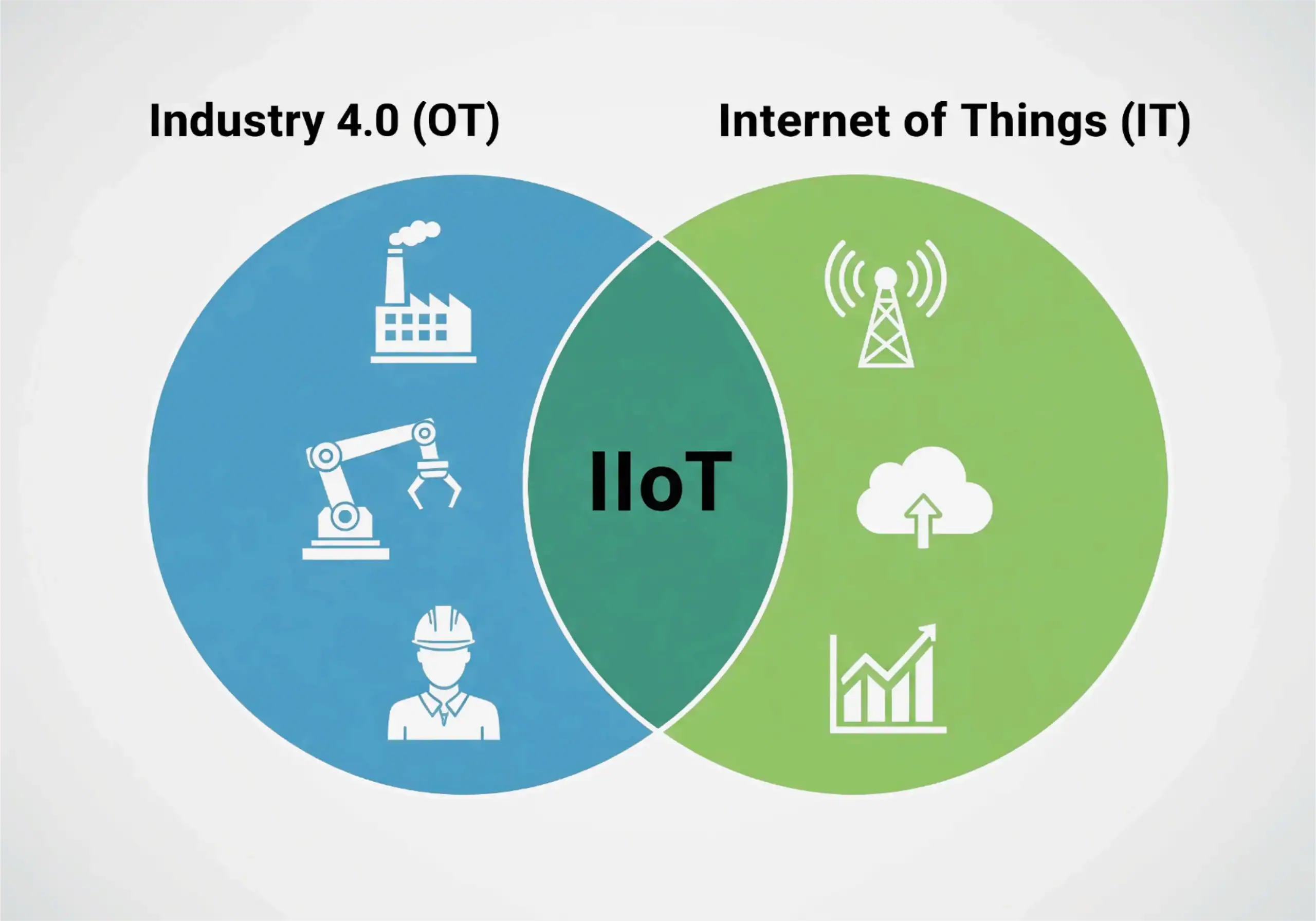
What is IIoT, and why is it redefining modern manufacturing? While Consumer IoT focuses on personal convenience, the Industrial Internet of Things (IIoT) is built for mission-critical reliability and large-scale industrial assets. This guide provides a professional deep dive into the IT/OT convergence, using a clear Venn diagram to illustrate how physical Operational Technology (OT) merges with the digital intelligence of Information Technology (IT). What we will cover: The IT/OT Intersection: A structural breakdown of how protocol translation connects legacy machines to the cloud. IIoT vs. IoT: The critical differences in environment, lifecycle, and “mission-critical” stakes. Core Architecture: The 2026 essentials of IIoT—from intelligent sensors and Edge Computing gateways to high-resilience connectivity (5G/LoRaWAN). Scenario-Driven Applications: Real-world ROI in predictive maintenance, smart grids, and precision agriculture. Future Trends: How AIoT and ESG/Sustainability are driving the next phase of industrial intelligence. By the end of this guide, you will understand how data-driven insights transform reactive, isolated factories into predictive, AI-powered ecosystems.
What we will cover: The IT/OT Intersection: A structural breakdown of how protocol translation connects legacy machines to the cloud. IIoT vs. IoT: The critical differences in environment, lifecycle, and “mission-critical” stakes. Core Architecture: The 2026 essentials of IIoT—from intelligent sensors and Edge Computing gateways to high-resilience connectivity (5G/LoRaWAN). Scenario-Driven Applications: Real-world ROI in predictive maintenance, smart grids, and precision agriculture. Future Trends: How AIoT and ESG/Sustainability are driving the next phase of industrial intelligence. By the end of this guide, you will understand how data-driven insights transform reactive, isolated factories into predictive, AI-powered ecosystems. Table of Contents Introduction: When Factories Start Talking A Simple Definition: The IT/OT Venn Diagram Explained IIoT vs. IoT: Why the "Industrial" Label Matters The 4 Core Components of an IIoT Architecture 1. Intelligent Sensors & Actuators (The Senses) 2. The Industrial IoT Edge Gateway (The Commander) 3. Connectivity (The Pathway) 4. The Cloud & Digital Twins (The Central Brain) Real-World IIoT Applications: Scenario-Driven Value 2026 Trends: The Rise of AIoT and ESG Conclusion: From Connection to Intelligence FAQs Q1: Can I implement IIoT on old machinery? Q2: Is IIoT the same as Industry 4.0? Q3: What do I need to get started with an IIoT project? Q4: How does IIoT improve safety in industrial settings? Introduction: When Factories Start Talking Imagine a busy factory. A PLC (Programmable Logic Controller) runs a production line. A robotic arm performs tasks with precision. An experienced engineer makes their rounds. This is the traditional industrial scene—efficient, but isolated. Now, imagine if every sensor and machine could “talk”. They send real-time status and health data securely to the cloud. This is not just connectivity. It is the transition from reactive to predictive operations. Definition: The Industrial Internet of Things (IIoT) is the extension of IoT into industrial sectors. it focuses on the deep integration of Operational Technology (OT) and Information Technology (IT) to drive smarter business decisions. Illustration of difference between IIoT and IoT. A Simple Definition: The IT/OT Venn Diagram Explained To understand IIoT, we must look at the intersection of two distinct technological worlds. The “Industry 4.0” Circle (Operational Technology – OT): This is the physical “muscle”. It includes robots, CNC machines, and the skilled people on the shop floor. OT focuses on availability and safety. These machines often run for decades in harsh environments. The “Internet of Things” Circle (Information Technology – IT): This is the “brain.” It includes 5G networks, cloud computing, and big data analytics. IT focuses on confidentiality and data integrity. It evolves rapidly through software updates. The Intersection: The IIoT Bridge. This is where the magic happens. By equipping OT assets with intelligent gateways, we create a feedback loop. Protocol Translation is the key here. It converts legacy “fieldbus” languages (like Modbus or Profibus) into modern “cloud-friendly” languages (like MQTT or JSON). This allows a 20-year-old motor to “chat” with a cutting-edge AI in the cloud. IIoT vs. IoT: Why the “Industrial” Label Matters This is a common point of confusion. While IIoT is a subset of IoT, they are worlds apart in their purpose, environment, and the stakes involved. The primary differentiator is Mission-Criticality. Feature Consumer IoT Industrial IoT (IIoT) Primary Goal Convenience, comfort, entertainment Efficiency, safety, productivity, profitability Environment Home, office (controlled environments) Factory, mine, outdoors (harsh, hazardous) The Stakes A failed smart bulb is an inconvenience. A failed PLC shuts down an entire production line. The Devices Smartwatches, smart speakers Industrial gateways, PLCs, high-precision sensors In short: Consumer IoT is about the User. Industrial IoT is about the Asset.”