HIGHLIGHTS
✔ Center-pivot irrigation systems are a great way to use water resources where exactly needed, reduce water consumption rates, and offer farmers convenience and efficiency. But to maximize their potential, they must be connected to a network for remote access, management, and control.
✔ Since crop fields are located in rural areas, providing network connectivity for the irrigation system isn’t an easy task. Luckily, we have just the right router for that – R9660S.
✔ With a cellular connectivity option, carrier aggregation feature, and other perks like GNSS and multiple interfaces, R9660S is sure to equip the entire irrigation solution with robust, uninterrupted connectivity that enables remote access, saving farmers tons of labor costs and time.

THE CHALLENGE – OUTDATED IRRIGATION
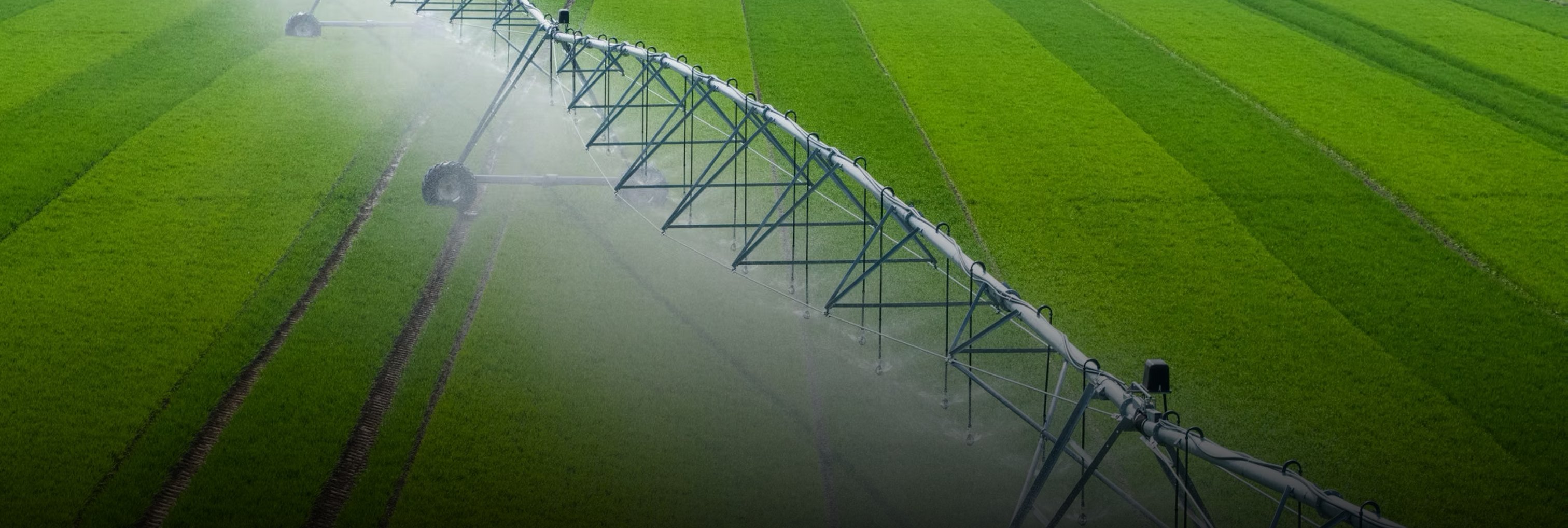
Every living creature on our planet relies on water to survive. Despite its fundamental role in our environment, ecosystems, and food supply, the ways we treat water resources aren’t necessarily the smartest. Current water consumption statistics reveal that agriculture takes up to 70% of all global water withdrawals. However, this percentage is estimated to only increase, as we’re about to welcome 2 billion more people into the world by the end of 2050. And yes, it makes sense that this amount of water gets dedicated to growing crops we feed farm animals with. Still, a whopping 40% of the water farmers use in their crop fields gets wasted due to outdated and poorly thought-out irrigation practices. Luckily, there are ways to solve this issue, one of them being center-pivot irrigation systems. These can reduce water consumption by automating the entire crop field irrigation process, including applying fertilizers and other chemicals to crops. But the potential doesn’t stop there. With the help of network connectivity, such systems help farmers save time, reduce labor costs, and increase efficiency by providing remote access to the system. This allows irrigation scheduling based on specific criteria or environmental conditions. However, achieving such cool things isn’t easy, as crop fields are located in rural areas without excellent network coverage. That’s why a solution like this must be equipped with the best network connectivity devices.
THE SOLUTION – PIVOTING TO AUTOMATION
Our R9660S cellular router is a feature-rich powerhouse, making it the perfect candidate to enable Machine-to-Machine (M2M) communication and deliver robust network connectivity.
First and foremost, the R9660S uses cellular networks as its primary internet source, ensuring a stable and uninterrupted connection for the entire center-pivot irrigation system—even in remote rural areas. It also supports carrier aggregation, which merges two frequency bands to significantly boost data transmission bandwidth. This technology enhances network reliability through improved coverage and stability, which is crucial for solutions deployed in remote locations.
So, what specific opportunities does this reliable connectivity unlock?
The primary advantage of a robust network is the ability to facilitate M2M communication, allowing seamless data exchange between pivot controllers, monitoring centers, and third-party applications. This brings full visibility to the irrigation system's status and data remotely. Farmers can track, control, and adjust the system without needing to travel to every single point. Whether it's managing component operating hours or monitoring a vast amount of data, it can all be done anytime, anywhere!
Another highlight of the R9660S is its GNSS (Global Navigation Satellite System) feature, which is particularly useful for farmers with multiple irrigation systems scattered across their fields. If a pivot system fails, it not only sends an alert to the monitoring center but also provides its exact location via GNSS. This allows farmers to quickly and easily identify which pivot has stopped working and take immediate action.
Additionally, our router is equipped with a rich set of interfaces, including serial ports and Ethernet. These interfaces make the device easily adaptable to various pivot systems that may require different connection types.
This solution not only helps reduce water consumption costs—thereby lowering the share of global water withdrawals—but also empowers farmers to perform their daily tasks much more efficiently.